

July 12, 2026

The best shop is the one that matches your damage, your vehicle, and your safety needs - not just the lowest quote.
If I were picking a body shop today, I’d check 6 things first:
That matters because hidden damage is common after a crash, and many collision jobs take about 7 to 14 days. On newer vehicles, bad repair work can also affect ADAS, airbags, alignment, and paint match.
Here’s the short version: match the shop to the job, ask about parts and scans, read the estimate line by line, and look for review patterns instead of star ratings alone.
| What I’d Check | What I’d Want to See | What Would Make Me Walk Away |
|---|---|---|
| Damage fit | Shop handles dents, paint, collision, or frame work like mine | Shop treats every repair the same |
| Vehicle size | Can take cars, trucks, or RVs with the right booth size | No room or gear for my vehicle |
| Training | I-CAR Gold Class, ASE, OEM repair steps | Vague answers about training |
| Equipment | Frame measuring, color match system, pre/post scans | No scan process, no measuring data |
| Estimate | Itemized charges, parts listed, supplement process explained | One total price, no breakdown |
| Warranty and claims | Written warranty and help with insurance paperwork | No clear warranty, weak claim support |
| Reviews | Good notes on paint match, timing, and communication | Repeat complaints about delays or surprise fees |
Bottom line: I’d choose the shop that gives clear answers, a written breakdown, and a repair plan that covers both visible and hidden damage.
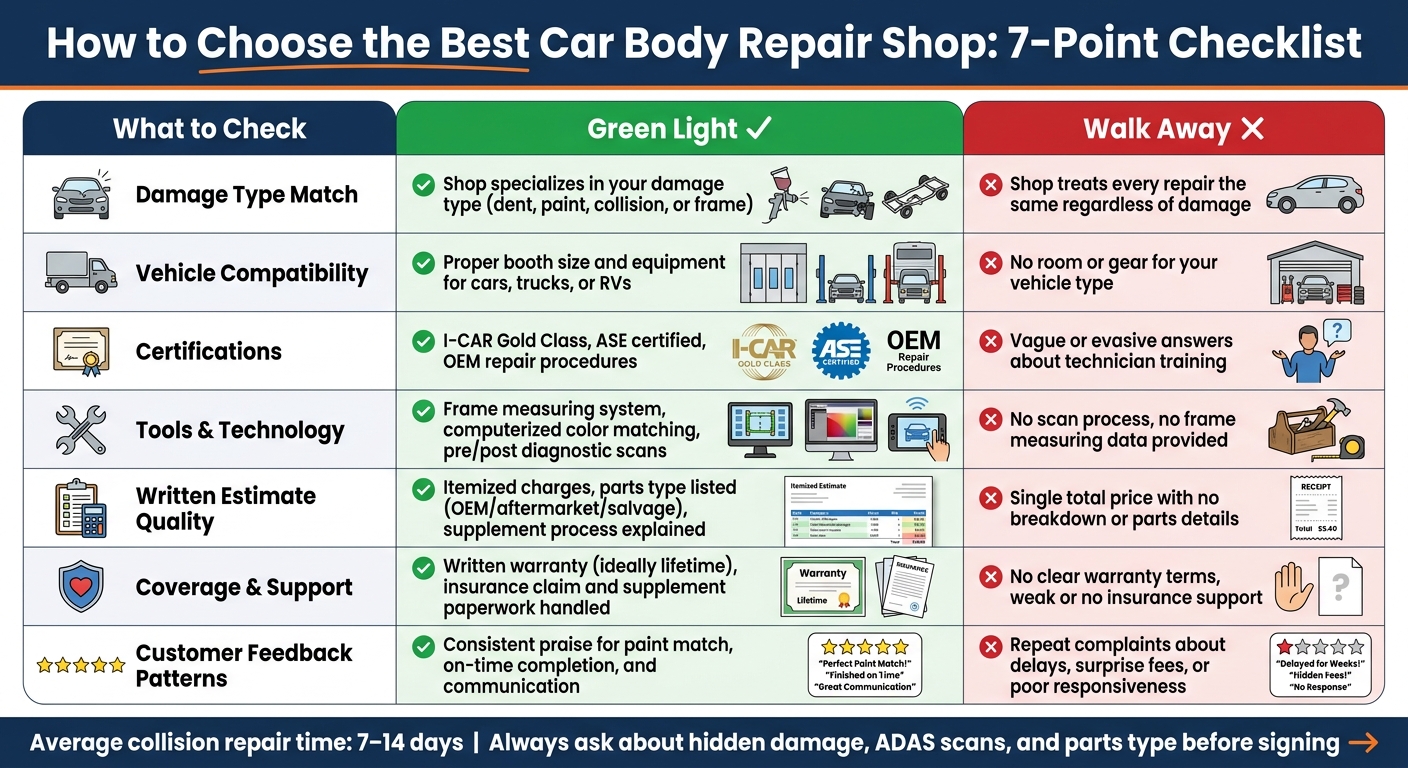
How to Choose the Best Car Body Repair Shop: 7-Point Checklist
Different damage calls for different repair setups. If you match the damage to the right shop early, you can save yourself time, back-and-forth, and a lot of hassle.
The right repair depends on the actual damage, not just what you can see at first glance.
Paintless dent repair (PDR) is a good fit for small dings and hail damage when the paint is still intact. It keeps the factory finish in place and is often a fast, lower-cost option. Body and paint work comes into play when scratches or deeper dents need sanding, reshaping, and refinishing. A repaired panel should look smooth under angled light, with no ripples, waves, or visible filler.
Collision repair deals with multi-panel accident damage and is meant to return the vehicle to its pre-accident condition, both in how it looks and how it performs structurally. Frame repair and straightening is needed when an impact affects the vehicle’s structure. That work depends on specialized machines and computerized measuring systems to bring the frame back to factory tolerances.
Surface damage can hide bigger problems underneath. A dent near a wheel well, for example, may point to suspension damage or wheel misalignment. If a shop only checks what’s on the outside, it can miss what’s going on below the surface. That’s why the first estimate should account for both visible and hidden damage.
Once you know the repair type, make sure the shop can actually handle your vehicle. Size matters here. RVs and motorhomes need shops with oversized paint booths and techs who know how to work on larger body structures.
It’s smart to confirm the shop has a booth big enough for your vehicle and the right training for large-body repairs. Before you schedule an estimate, check that the shop has the booth size and repair equipment needed for your exact vehicle.
Once the shop matches both your damage type and your vehicle size, the next step is to look at its training and equipment.
Once you’ve matched a shop to your vehicle and the type of damage, take one more step: make sure the team has the training and tools to do the job right. That matters because body repair isn’t one thing. Structural work, paint work, and electronic repairs all call for different skills and equipment.
ASE and I-CAR (Inter-Industry Conference on Auto Collision Repair) certifications are standard credentials in collision repair. I-CAR Gold Class means the shop’s technicians keep up with training over time, instead of passing a test once and moving on.
If your vehicle has aluminum, high-strength steel, or ADAS features, manufacturer-specific training matters even more. OEM repair procedures help make sure the vehicle’s structure, airbags, and safety systems work the way they should after repairs.
For structural repairs, the shop should use a computerized measuring system to confirm proper frame alignment. On the paint side, ask what system they use. Computerized color matching helps deal with fading and factory paint differences, which can be the difference between a close match and a paint job that sticks out.
Modern vehicles are also packed with electronics. A shop that handles these repairs well should perform pre-repair and post-repair diagnostic scans to find hidden damage involving ADAS sensors, airbag systems, and other electronics affected by the crash.
This is the part where a short checklist can save you a headache later:
Straight answers usually point to a shop with a clear repair process. If the answers feel fuzzy or evasive, that’s a warning sign. From there, you can move on to comparing estimates, warranty terms, insurance handling, and turnaround time.
Once you've confirmed the shop has the right training and equipment, shift to the practical stuff: cost, coverage, and how long you'll be without your car.
A written estimate should spell out each charge clearly - labor, parts, paint and materials, plus added fees like diagnostic scans or hazardous waste disposal. If you only see one total number, ask for an itemized estimate before you sign anything.
The parts column matters more than many people think. The estimate should say whether the shop plans to use OEM, aftermarket, or salvage parts. That choice can affect fit, safety, and how well the repair holds up over time. In some cases, manufacturers require OEM parts for structural repairs and safety systems.
It's also smart to ask how the shop deals with supplements. Those are added charges that come up after teardown reveals hidden damage. That part is common in collision work, so it helps to know how the shop explains and documents those costs.
Price matters, of course. But the lowest number on the page shouldn't beat safety, fit, or long-term durability.
When you compare estimates, look at:
Not just the grand total.
A good repair warranty should cover workmanship, paint, and parts. Best case, it lasts as long as you own the vehicle. Some shops also offer transferable warranties, which may help your car hold more resale value if you sell it later.
Insurance help can save you a lot of back-and-forth. It's smart to lean toward shops that handle claim communication and supplement paperwork for you. A shop you can count on will document added damage and push for OEM parts when an insurer pushes back on coverage.
Average wait times for collision repairs usually fall between 7 and 14 days. Bigger jobs can take longer, especially if parts are backordered, insurance approval drags out, or paint needs time to cure.
Before you hand over the keys, ask what might delay the job. That one question can save a lot of frustration later. It also helps to ask how often you'll get updates and whether those updates come by text, phone, or email. Regular communication builds trust and cuts down on surprises.
Next, use reviews and red flags to check whether the shop actually does what it says.
Star ratings are useful. But at this point, patterns tell you more.
What matters now is simple: compare what a shop says it will do with what customers say it actually did. A five-star average can look nice at a glance, but repeated comments often tell the real story.
Use reviews to back up what you already checked in person, especially repair quality, communication, and follow-through. Look at Google, Yelp, and Facebook, not just the shop’s own website. Then scan for repeat comments about paint match, panel gaps, estimate accuracy, and how long the repair took.
Recent reviews deserve extra weight. A shop may have done solid work two years ago and slipped since then. Here’s a quick guide to what’s worth noticing and what should make you pause:
| Review Category | Positive Patterns (Pros) | Red Flags (Cons) |
|---|---|---|
| Work Quality | Seamless paint blending; consistent panel gaps; flat, even panels | Waves in the panel or paint; visible sanding marks; crooked gaps |
| On-Time Completion | Repairs finished on the promised date; regular updates | Repeated delays without explanation; missed pick-up dates without notice |
| Estimate Accuracy | Final bill matches the itemized written estimate; clear explanation of supplements | Vague initial quotes; surprise charges for minor tasks; no written breakdown |
| Customer Service | Answers questions directly; keeps customers updated; responsive to calls or texts | Avoidance of technical questions; pressure to use salvaged or non-OEM parts; poor responsiveness |
Reviews show the pattern. Your visit tells you if that pattern holds up when you’re standing in the shop.
Online, be careful with shops that don’t mention certifications, bury charges inside vague quotes, or keep getting complaints about surprise fees. In person, the warning signs are often easier to spot. If someone dodges direct questions, pushes salvaged or non-OEM parts without a clear reason, or won’t give you an itemized breakdown, that’s a bad sign.
A clean, organized shop often points to a crew that pays attention to details. It’s not a guarantee, but it’s part of the picture. And if you can already see uneven panel gaps or waves in the paint on cars sitting in the lot, that shop probably doesn’t belong on your shortlist.
Pick the shop that fits your damage, explains the process in plain English, and gives you confidence before the work even starts.
Hidden damage after a collision can affect your car’s mechanical, electrical, and structural systems. Some problems are easy to miss at first glance, which is why a professional shop should check the vehicle with thorough diagnostics. That usually includes pre- and post-repair scans along with inspections for issues like suspension misalignment or frame damage.
Choose a shop that follows OEM-approved procedures and documents all needed repairs for your insurance carrier so nothing gets overlooked.
OEM parts are usually the best pick if you want to keep your vehicle’s performance, safety, and manufacturer warranty in good shape. They’re made by your vehicle’s manufacturer, so the fit is right and the quality tends to stay consistent.
If you go with aftermarket parts, try to choose CAPA-certified options when you can. It also helps to talk through your part choices with your repair shop and insurer early, so the final estimate lines up with what your vehicle needs.
Stay in clear, professional contact with the shop. Ask about its current workload, the status of any parts on order, and whether the team found hidden damage after the first inspection.
Delays happen. Sometimes an insurance review slows things down. Other times, a part shows up and doesn’t fit the way it should.
The best move is to set the tone early. Ask for regular updates from the start so you’re not left guessing. A good shop should be able to explain what’s causing the delay and give you a revised timeline.
