

August 30, 2026
The short answer: I’d pick a Utah auto body shop based on training, repair tools, estimate detail, insurance help, reviews, and written warranty terms - not just price or how close it is.
If I were making a fast decision after a crash, I’d focus on a few things first:
A few numbers stand out. Only about 20% of U.S. body shops have I-CAR Gold Class status. OEM parts can cost about 10% to 30% more than aftermarket parts. And for newer vehicles, missing ADAS scans and calibration can be a problem after repairs.
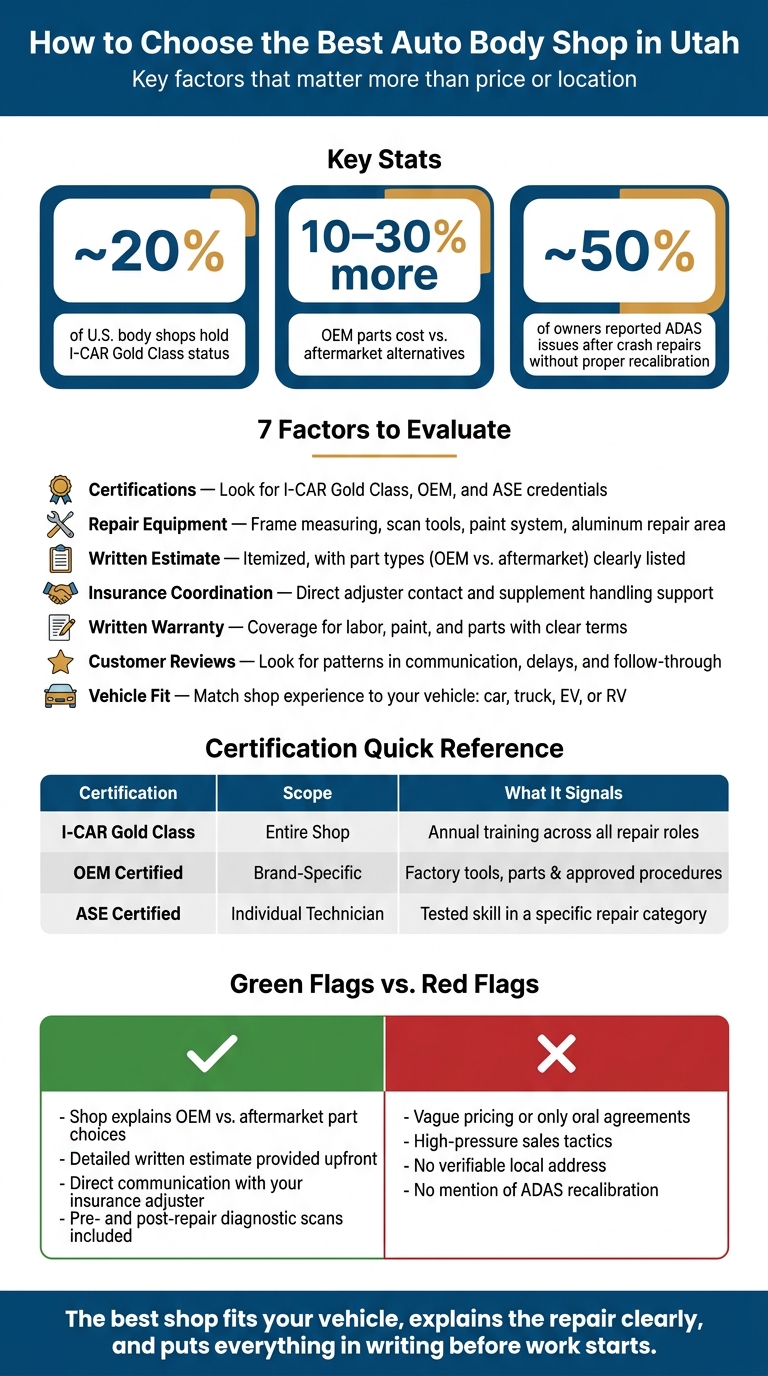
How to Choose the Best Auto Body Shop in Utah
| What I’d Check | What I’m Looking For | Why It Matters |
|---|---|---|
| Certifications | I-CAR, OEM, ASE | Shows training and brand-specific repair ability |
| Repair equipment | Frame measuring, scan tools, paint system, aluminum area | Helps show the shop can handle the job |
| Estimate | Written, itemized, part types listed | Cuts down on billing surprises |
| Insurance help | Direct adjuster contact, supplement handling | Makes claim steps easier |
| Warranty | Written terms for labor, paint, and parts | Helps if something goes wrong later |
| Reviews | Repeated comments on updates, delays, and follow-through | Shows how the shop treats customers |
| Vehicle fit | Experience with cars, trucks, EVs, or RVs | Not every shop fits every repair |
Bottom line: I’d choose the shop that matches the vehicle, explains the repair in plain language, and puts everything in writing before work starts.
"Certified" can mean a lot of different things. Before you hand over your keys, it helps to know which credentials carry weight.
I-CAR Gold Class is the main training standard for the shop as a whole. It calls for annual training across the team, including estimators, structural technicians, and refinish specialists. Only about 20% of U.S. body shops hold it, so it's a solid first filter. You can check a shop's current Gold Class status at i-car.com through the public shop locator.
OEM certifications come straight from automakers like Ford, Tesla, BMW, Toyota, and Honda. These programs call for brand-specific tools, OEM repair procedures, and, in many cases, special equipment such as ADAS calibration targets or aluminum welding tools. A shop may need to spend more than $50,000 on equipment alone to qualify. To confirm a shop's status, use the automaker's certified collision center locator or call customer service.
ASE certifications apply to individual technicians, not the entire shop. Credentials like B3 for structural repair and B6 for refinishing show that a technician passed a proctored exam in that repair area. You can verify them on the ASE website or ask to see the technician's physical certificate.
Use these credentials as a quick way to narrow the field before you dig into repair methods and equipment.
| Certification | Scope | What It Signals |
|---|---|---|
| I-CAR Gold Class | Entire shop | Annual training across all repair roles |
| OEM Certified | Brand-specific | Factory tools, parts, and approved procedures |
| ASE Certified | Individual technician | Tested skill in a specific repair category |
How long a shop has been in business matters less than whether it has done this kind of repair on your type of vehicle.
For newer vehicles, ask if the shop pulls OEM repair procedures for your VIN and recalibrates safety systems after the repair. That's a simple question, but it tells you a lot.
For RV and motorhome repairs, the bar is different. Most standard body shops don't have the room or the gear for that kind of work. You want a facility with an oversized paint booth and heavy-duty frame straightening equipment built for the size and weight of a motorhome.
A short walk through the shop can tell you plenty. Look for a computerized frame measuring system. Good structural repair work should be checked against factory specs with precision in the 0.1 mm to 1 mm range.
Also ask if the shop does both a pre-repair diagnostic scan and a post-repair scan. That helps confirm the vehicle's safety systems are checked before work starts and reset once the repair is finished.
For paint work, look for a computerized paint-mixing system and proper curing equipment. If your vehicle has aluminum body panels, the shop should also have a dedicated aluminum repair area.
Once a shop clears those basics, then it makes sense to compare estimates, insurance handling, and warranty terms.
Once you’ve narrowed your list to shops with solid credentials and the right equipment, it’s time to compare estimates, insurance handling, and warranty terms. This part matters more than most people think. A cheap quote doesn’t help much if it leaves out work your car actually needs.
A written estimate should be detailed enough that you can see what the shop plans to do and why.
Here are some of the terms you’ll usually spot:
| Term | What It Means |
|---|---|
| R&I | Remove and Install - the part comes off, gets repaired or moved aside, then goes back on |
| R&R | Remove and Replace - the damaged part is discarded and a new one is installed |
| Blend | Painting into adjacent panels so the new paint matches the surrounding finish |
| Supplement | An updated estimate for hidden damage found after the vehicle is torn down |
| Sublet | Work sent to a third party, such as glass replacement or dealer-only ADAS calibration |
One thing to watch closely is part type. The estimate should say whether the shop plans to use OEM parts, aftermarket parts, or recycled parts. OEM parts usually cost 10% to 30% more than aftermarket options, but they’re made by the original manufacturer, so fit is exact and factory warranty protection is easier to keep in place. Aftermarket parts can be fine, but quality and fit can vary, and some need extra adjustment before they sit right.
You’ll also want to check for pre-repair and post-repair diagnostic scans and ADAS recalibration for cameras, radar, and sensors. That line item isn’t filler. It matters. About 50% of vehicle owners who had crash avoidance features repaired said they had problems with the system afterward. If a late-model vehicle estimate doesn’t include those steps, there’s a good chance the quote is missing work.
It’s also smart to ask how the shop handles hidden damage. A good shop should explain how it documents new findings and sends supplements for approval before more work moves ahead.
A detailed estimate can also help move insurer approval along with less back-and-forth.
Utah drivers have the legal right to choose their own repair shop. An insurance company can suggest a “preferred” shop, but it can’t force you to use one. A good shop should tell you that right away, not dance around it.
Strong insurance coordination usually means the shop deals directly with the adjuster, explains the repair steps, sends in photos and paperwork, and pushes back when there’s a dispute over parts or labor rates. That can save you a lot of phone calls and a fair amount of stress.
Shops that follow OEM repair procedures are often in a better spot when these disputes come up. Why? Because they can point to the manufacturer’s own instructions instead of arguing from opinion. That usually makes it easier to support the work the vehicle needs.
Ask one more thing: does the shop do a full teardown before it locks in the estimate? Shops that inspect the vehicle early tend to catch hidden damage sooner. That makes supplements easier to process and helps the claim move with fewer surprises.
Once the claim side is in order, compare warranty terms line by line.
A warranty only has value if the terms are clear. Don’t settle for vague promises like “we stand behind our work.” You want the actual coverage in writing, especially for workmanship, paint, and parts.
Most good shops lay it out like this:
| Warranty Type | Typical Duration | What's Covered | Common Exclusions |
|---|---|---|---|
| Workmanship | Lifetime of vehicle ownership | Alignment, welding, assembly, labor errors | Normal wear and tear, new damage |
| Paint/Refinish | Lifetime or 5+ years | Peeling, cracking, fading, loss of gloss | Stone chips, bird droppings, environmental damage |
| OEM Parts | 12 months / 12,000 miles | Mechanical or structural failure of the part | Labor to replace the failed part (unless specified) |
| Aftermarket Parts | Varies, often 1 year | Part failure or fitment issues | Labor for re-installation, finish matching |
Read those terms with care. For example, a parts warranty may cover the failed part itself but not the labor to remove and replace it. That small detail can turn into an out-of-pocket bill later.
Always get warranty terms in writing before you approve any repair work.
Once the estimate is done, reviews can tell you something the paperwork can't: how the shop treats people after the handoff. A shop may look polished up front, but feedback from past customers often shows whether it communicates well, sticks to the plan, and handles problems like an adult.
Check Google, Yelp, BBB, and Carwise. Then zoom out. Don’t get hung up on one angry review or one glowing one. Look for patterns that show up again and again.
If several reviewers mention clear updates, honest timelines, and smooth insurance claim handling, that’s a strong sign. If you keep seeing complaints about delays, surprise charges, or poor follow-through, pay attention. Those patterns matter more than a shop’s star rating by itself. Replies to complaints matter too. Professional, calm responses can signal accountability.
Use these signs to judge the repair process itself, not just how polished the front desk feels.
| Sign | What It Means | How Utah Drivers Should Respond |
|---|---|---|
| Willingness to explain parts choices | Shop is open about OEM vs. aftermarket decisions and repair methods. | Green flag - if a shop can walk you through its reasoning, that’s a good sign. |
| Vague pricing or oral agreements | Higher risk of hidden fees or disputes after the work is done. | Red flag - ask for a detailed, itemized written estimate before you approve anything. |
| High-pressure tactics | Shop is pushing volume over repair quality and safety. | Red flag - a solid shop gives you time to make an informed call. |
| No verifiable local address | This comes up often with mobile hail-dent services; if something goes wrong, you may have no clear path to fix it. | Red flag - stick with shops that have a stable, verifiable local facility. |
Reviews show how a shop handles issues. The pickup inspection shows whether the repair was done right.
Before you leave, inspect the vehicle in natural daylight. It’s one of the simplest ways to spot problems that indoor lighting can hide.
After you compare credentials, estimates, and reviews, line the shop up with the exact repair your vehicle needs.
Start with repair type. Then think about location.
Minor dents, hail damage, and parking lot dings are often a good fit for paintless dent repair (PDR). PDR tends to work best when the paint is still intact. It can save time, cost less, and keep your vehicle’s original factory finish in place, which may help hold resale value.
Frame damage calls for a shop that has computerized frame measuring equipment.
If you drive an aluminum-body vehicle, an EV, or a car packed with ADAS features, the shop needs the right tools, safety training, and calibration ability. That’s not a nice-to-have. It’s part of doing the job right.
RV and motorhome repairs need oversized bays and heavy-duty repair equipment. A standard body shop may not be set up for that kind of work.
Once you know the repair type, use the checklist below to narrow your final pick.
Before you commit to a shop, check these basics:
| What to Check | What to Look For |
|---|---|
| I-CAR, ASE, or OEM | I-CAR Gold Class, ASE, or OEM certification for your vehicle make |
| Your vehicle type | Experience with your specific vehicle type - car, truck, EV, or RV |
| Written estimate | Written estimate with part types listed |
| Written warranty | Written warranty for parts and labor |
| Consistent feedback | Consistent reviews on communication and follow-through |
| Calibration capability | In-house calibration equipment for cameras and sensors, or a clear plan for recalibration |
The best shop is the one that fits your vehicle, explains the work clearly, and documents every step.
Focus on quality, not just the lowest price. Get estimates from a few shops so you can compare both cost and service side by side.
What matters most isn't hitting some magic number of quotes. It's making sure each estimate is written, detailed, and clear about the procedures, parts, and warranties included. That way, you can see what you're paying for and avoid hidden fees or last-minute surprises.
Yes, but it depends on your policy and the claim.
Some insurers cover OEM parts. Others use aftermarket parts by default to keep claim costs down.
In some cases, OEM coverage is optional or only included with an endorsement. It’s worth asking your insurer what your policy covers and whether you’d have to pay any extra if the claim only includes aftermarket parts.
Repair time comes down to how bad the damage is.
Minor cosmetic repairs usually take 2 to 4 days. Moderate repairs often need 5 to 10 days. Severe structural repairs can take 10 to 20 or more days.
Your shop should include an expected turnaround time in the repair estimate. That gives you a rough idea of what to expect before work starts.
For the closest estimate, ask your technician about your vehicle’s exact damage. A small dent and a bent frame may both count as “damage,” but they’re obviously not in the same league.
